


How your microbiome sets the pace of your gut

Most of us picture the gut as simple plumbing: food goes in one end, waste comes out the other, and the tube in between just pushes things along. The reality is far more interesting. The movement of your bowel — its motility — is a finely timed performance, coordinated by a dense network of nerves and shaped, moment to moment, by the trillions of microbes living inside you.
When that timing works, you barely notice it. When it drifts too slow, you get constipation, bloating and that heavy, incomplete feeling. Too fast, and it's urgency and loose stools. A great deal of what we now call disordered gut motility — including much of irritable bowel syndrome — sits somewhere in this spectrum of mistimed movement.
What has changed in the last decade is our understanding of why the timing drifts. The gut microbiome is no longer a bystander to digestion; it is an active co-conductor of motility. This piece follows three threads of that story — the chemical messengers microbes make, the gas-producing archaea that act as a brake, and the nervous system that ties it all together — and finishes with what we can actually do about it.

The gut has a tempo — and microbes help set it. Slowing brakes (methane, dysbiosis, low fibre) pull toward constipation; propulsive drivers (SCFAs, serotonin, keystone microbes) support a coordinated rhythm.
A quick cast of characters
Three players carry most of this story, so it's worth a brief introduction.
First, the enteric nervous system — often called the gut's "second brain." It's a mesh of roughly a hundred million neurons woven through the wall of the intestine, and it can generate and coordinate the waves of contraction that move contents along, largely on its own. It also listens closely to chemical signals from the gut lining.
Second, the microbiome itself: trillions of bacteria, plus a smaller population of archaea and fungi. You'll often see it summarised as a ratio of two big bacterial groups, Firmicutes and Bacteroidetes. That shorthand is worth treating with caution — it's a coarse, much-debated summary, and what actually matters for motility is not which broad phylum dominates but which functions are present: who is fermenting fibre, who is making which metabolite, and who is producing gas.
Third, the metabolites — the small molecules microbes release as they feed. This is the language microbes and nerves use to talk to each other, and it's where the most important motility signals are written.
Microbes don't push the gut directly. They change its chemistry — and the nervous system reads that chemistry as instructions.
Short-chain fatty acids: the gut's chemical messengers
When you eat fibre that your own enzymes can't break down — the resistant starches, pectins and inulins in vegetables, legumes, whole grains and fruit — it travels intact to the colon. There, bacteria ferment it and release short-chain fatty acids, or SCFAs. The three that matter most are acetate, propionate and butyrate.
These molecules are extraordinarily busy. Butyrate is the preferred fuel of the cells lining your colon, which quietly makes it central to gut health. But SCFAs are also signals. They dock onto specific receptors — the free fatty acid receptors FFAR2 and FFAR3 — that sit on hormone-releasing cells and on enteric nerves themselves. And crucially for motility, SCFAs prompt specialised cells in the gut lining called enterochromaffin cells to release serotonin, one of the master switches of peristalsis.

From a plate of fibre to a wave of movement — fibre is fermented into SCFAs, which fuel the colon lining, signal through FFAR2/FFAR3, and trigger serotonin release that helps drive coordinated peristalsis.
Here's the honest nuance, and it's one worth keeping. SCFAs are not a simple "accelerator pedal." They are modulators — their net effect on movement depends on which SCFA, in which part of the gut, at what concentration, and against what background. In much of the colon they support serotonin-driven propulsion; in other settings and regions they can dampen and slow contractions instead. The unifying idea is not "SCFAs speed everything up," but rather that a well-fed, SCFA-rich gut tends to move in a coordinated, well-timed way, while an SCFA-poor gut loses that fine tuning.
The nervous connection: serotonin and the vagus
It surprises most people to learn that the overwhelming majority of the body's serotonin — well over 90% — is made not in the brain but in the gut, by those enterochromaffin cells. Down here, serotonin isn't about mood; it's a local conductor. Released into the gut wall, it acts on nerve endings to launch the peristaltic reflex — the coordinated squeeze-above, relax-below that walks contents toward the exit.
This is the hinge of the whole story. Microbes make SCFAs; SCFAs help set serotonin release; serotonin tunes the nerves that move the gut. Layer on the vagus nerve — a two-way cable between gut and brain — and you have a genuine, physical gut–brain axis: a conversation in which the microbiome has a real voice.
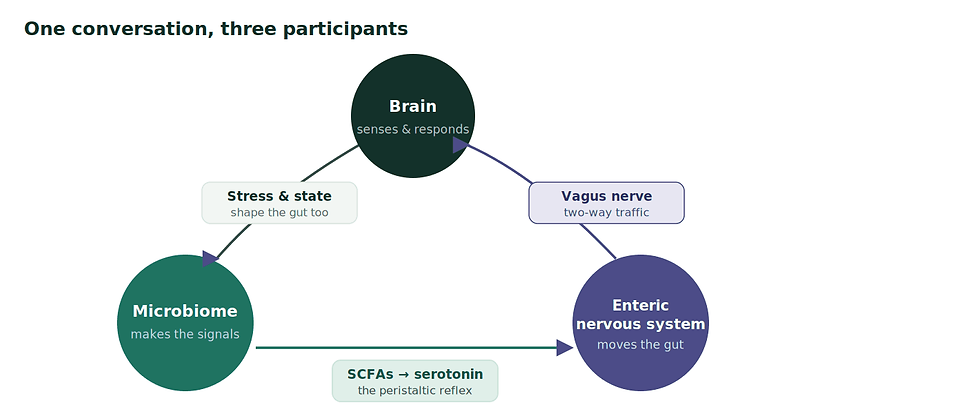
The gut–brain axis is a loop, not a one-way street: microbial metabolites shape serotonin and the peristaltic reflex, the vagus nerve carries signals up to the brain, and the brain's state feeds back down onto gut movement.
Methanogens and the methane brake
Now for the brake. A small but influential group of gut microbes aren't bacteria at all — they're archaea, and the dominant one in humans is Methanobrevibacter smithii. These methanogens do something unusual: they consume the hydrogen and carbon dioxide that other microbes produce during fermentation, and turn it into methane gas.
Methane is not an inert bystander. It has a consistent, well-documented effect: it slows the gut. Specifically, methane reduces the speed of the propulsive waves in the small intestine while increasing the number of non-propulsive, churning contractions — the kind that mix contents without moving them onward. The net result is slower transit through both the small bowel and the colon.

How methanogens put on the brakes — M. smithii turns fermentation gases into methane, which slows peristalsis and increases non-propulsive churning, tending toward constipation and bloating.
This is why a subset of stubborn constipation and bloating traces back to methane. When methanogens overgrow, the picture is now formally recognised as intestinal methanogen overgrowth (IMO) — the condition previously lumped in with "methane-positive SIBO." A breath test that measures exhaled methane can flag it, and it changes how we treat: you can add all the fibre you like, but if a methane brake is engaged, transit stays slow.
Keystone microbes and the cost of depletion
If methanogens are the brake, the butyrate producers are the gardeners that keep the whole ecosystem healthy. Species like Faecalibacterium prausnitzii and Roseburia — mostly from the Firmicutes group — are the main source of butyrate. Because butyrate fuels the colon lining, keeps oxygen low, and holds the gut barrier tight, these microbes are genuinely keystone species: remove them and the structure sags.
And here's the trap. When butyrate producers are depleted — by a low-fibre diet, illness, or a course of antibiotics — the colon cells lose their preferred fuel, oxygen leaks into the gut, and the environment shifts to favour less friendly, oxygen-tolerant microbes. That, in turn, crowds out the very butyrate producers that started the cascade. It becomes a self-reinforcing loop of dysbiosis: less butyrate, a leakier and more inflamed barrier, and less reliable motility signalling.
This isn't only a gut story. Depletion of these same butyrate producers turns up as a shared signature across inflammatory bowel disease and even neurological conditions such as Parkinson's and multiple sclerosis — one of the clearer hints that the gut–brain axis matters in disease, not just in theory.
Putting it together: drivers and brakes
Step back and the whole system resolves into a balance. On one side, forces that support propulsive, well-timed movement. On the other, forces that slow and disorganise it. Health isn't "maximum speed" — it's the two sides in balance, producing a gut that empties comfortably and completely.
Forces that turn motility up
SCFAs feeding serotonin and the peristaltic reflex
Abundant butyrate producers keeping the barrier tight
A diverse ecosystem fed by plenty of plant fibre
Healthy vagal, gut–brain signalling
Forces that turn motility down
Methane from overgrown methanogens (IMO)
Depleted butyrate producers and a leaky barrier
Low-fibre, low-diversity dysbiosis
Stress and disrupted gut–brain signalling
When the two sides drift out of balance, symptoms follow — and much of IBS lives here.
How we can influence it
The genuinely encouraging part is that this system is modifiable. None of the levers below is a magic switch, and the evidence is stronger for some than others — but together they represent a real, mechanism-based way to shift the balance rather than just chase symptoms.
Feed the fermenters
The single most reliable lever is dietary fibre — a wide variety of it, from vegetables, legumes, whole grains, nuts and fruit. Diversity of plants tends to buy diversity of microbes, and diversity is what makes SCFA production robust. This is unglamorous and it works.
Targeted prebiotics, probiotics and postbiotics
Specific prebiotic fibres (such as inulin and partially hydrolysed guar gum) can nudge SCFA output. Probiotic and butyrate/postbiotic supplements are an area of active research: effects are real but strain- and context-specific, so they're best chosen deliberately rather than at random off a shelf.
Release the methane brake
When methane is the problem, the approach is different. A breath test can confirm it; management may combine a lower-fermentation dietary phase with targeted antibiotic therapy for IMO, and newer methane-lowering strategies are being studied. The key clinical point: methane-predominant constipation often won't respond to "more fibre" alone.
Rebuild the ecosystem
Where the community itself is depleted or badly disordered, the most direct intervention is to restore it. Faecal microbiota transplantation (FMT) does exactly this — transferring a whole, diverse microbial community — and while its evidence base is best established for recurrent C. difficile infection, its role in motility and microbiome-driven disorders is an area of active and evolving investigation.
The bottom line
Motility is a conversation, not a conveyor belt. Microbes, metabolites and nerves continuously negotiate the pace of your gut.
Short-chain fatty acids are the currency. Fibre feeds them; they fuel the gut lining and help set the serotonin signals that coordinate movement.
Methane is a brake. Overgrown methanogens slow transit — a common, testable and treatable cause of stubborn constipation and bloating.
Keystone microbes matter more than ratios. Losing butyrate producers can tip the gut into a self-reinforcing loop of dysbiosis.
It's modifiable. Diet, targeted prebiotics, methane-directed treatment and, in the right cases, microbiome restoration all give us levers to pull.
A note from the clinic
In practice, matching the treatment to the mechanism is what makes the difference — which is why breath testing, microbiome assessment and, where appropriate, therapies such as FMT sit alongside dietary work in how we approach difficult motility and microbiome problems at Shore Gastroenterology. If persistent bloating, constipation or irregular bowel habit is affecting you, these are exactly the questions worth investigating properly.
Selected reading
Reigstad CS et al. Gut microbes promote colonic serotonin production through an effect of short-chain fatty acids on enterochromaffin cells. FASEB J, 2015.
Flint HJ, Louis P. Diversity, metabolism and microbial ecology of butyrate-producing bacteria from the human large intestine. FEMS Microbiol Lett, 2009.
Reviews on the gut microbiota–SCFA–motility axis and FFAR2/FFAR3 signalling in slow-transit constipation, 2024–2026.
Pimentel M, Rezaie A and colleagues on intestinal methanogen overgrowth (IMO) and methane's effect on transit, Cedars-Sinai.
This article is general educational information about gut physiology and the microbiome. It is not individual medical advice and is not a substitute for assessment by a qualified clinician. If you have symptoms or health concerns, please seek personalised advice from your doctor or a gastroenterologist.
Comments