

How to choose the right gastroenterologist in Sydney (it depends on what you need)

Updated: Sep 25
"Who's the best gastroenterologist in Sydney?" is a question I hear a lot, usually from friends of patients or from people who've been handed a referral and a list of names. The honest answer is that there isn't one. Gastroenterology is a broad specialty, and the right person for a routine screening colonoscopy is not always the right person for a complicated bile duct problem, advanced liver disease, or years of unexplained bowel symptoms.
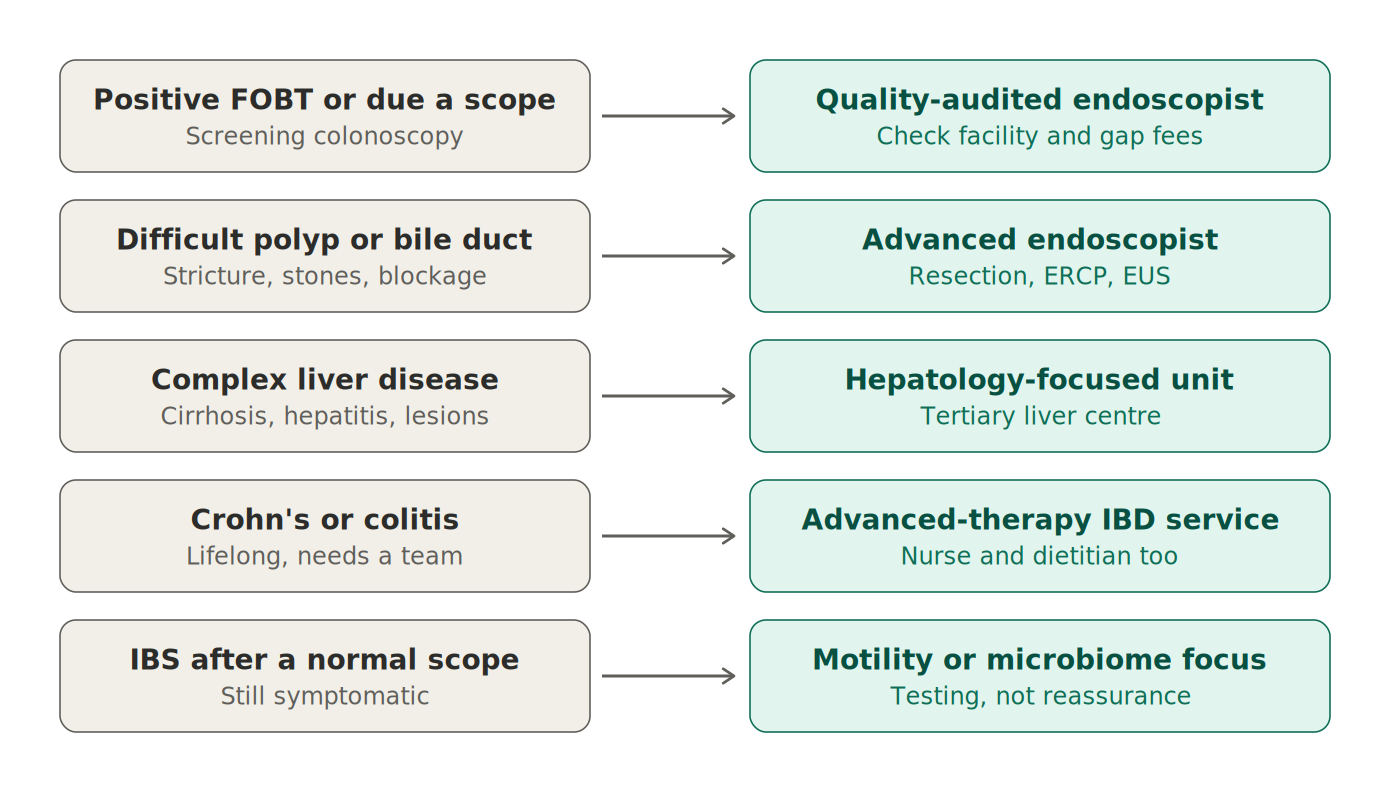
What matters is matching the specialist to the job. Below is how I'd think about it for the five situations that come up most often.
A note about the names in this article. I've mentioned a small number of Sydney colleagues where their subspecialty expertise is particularly relevant to the examples discussed. This is not a ranking, and the list is deliberately not exhaustive. I refer patients to different colleagues depending on the problem, location, hospital access and each patient's circumstances. Sydney has excellent gastroenterologists across the board; this is about fit.
1. Bowel cancer screening and a positive FOBT
If you've had a positive bowel screening test (iFOBT), or you're due for a screening or surveillance colonoscopy, you need a procedure done well, done promptly, and done without a financial surprise. Three things to weigh:
The endoscopist. Ask your GP who they'd send their own family to. GPs see the reports and the outcomes, so their view is a reasonable guide. Beyond that, look for an endoscopist who performs colonoscopy regularly and takes part in quality monitoring and recertification. Good colonoscopy services audit measures such as completion to the caecum, bowel preparation quality, and detection rates for adenomas and sessile serrated lesions, in line with the Australian Colonoscopy Clinical Care Standard. A clear report and a clear surveillance interval at the end are also signs you're in good hands.
The facility. A healthy 55-year-old can be scoped safely at a day surgery. Someone with significant heart or lung disease, on blood thinners, or with a complex medical history is better off in a hospital with anaesthetic support and backup on site. Ask where the procedure will be done and whether that's appropriate for you.
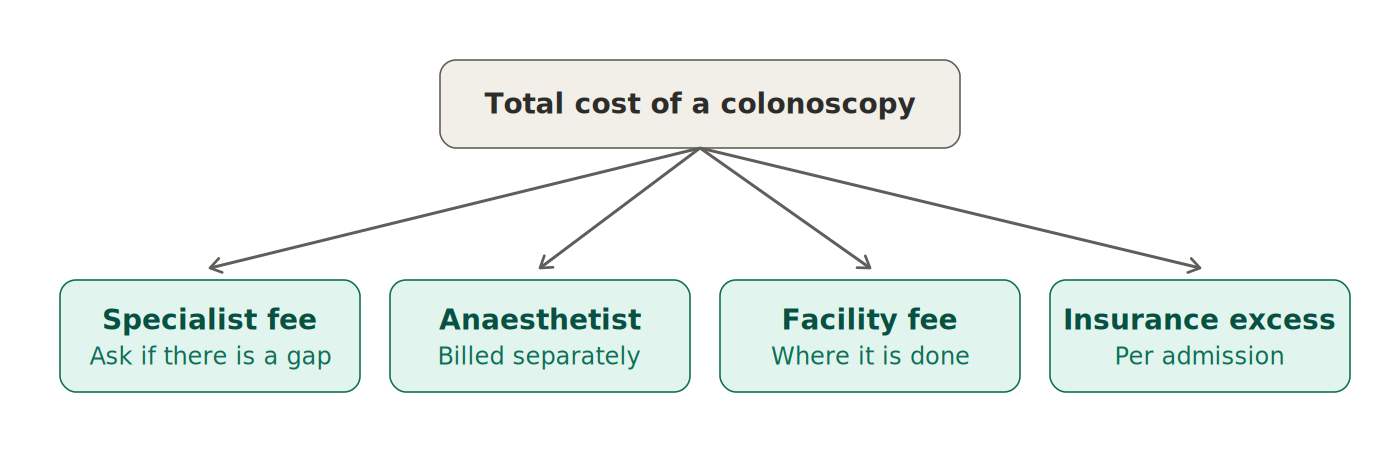
The cost. After a positive iFOBT, colonoscopy should be organised promptly — Australian guidance sets 120 days as the maximum interval, and clinical urgency may justify considerably earlier. Cost should never be the reason it's delayed. There are four separate components to ask about: the gastroenterologist's fee, the anaesthetist's fee, the facility or hospital fee, and any private health insurance excess. Ask directly which of these carry a gap. For my own patients at Shore Gastroenterology, colonoscopy is either bulk-billed or no-gap, depending on your insurance status, and the anaesthetist and facility arrangements are explained before you book. If you're quoted a large out-of-pocket fee for a routine screening scope, it's fair to ask your GP for another option.
I haven't named anyone in this section deliberately. Routine, high-quality colonoscopy isn't a celebrity contest — the criteria above are more useful than a name.
2. Complex polyps, ERCP, EUS and advanced endoscopy
Sometimes a colonoscopy finds a polyp too large or awkwardly placed to remove on the day. Sometimes there's a stricture in the oesophagus or bowel that needs more than a simple stretch, or a bile duct or pancreatic problem — stones, a blockage, a narrowing — that needs ERCP or endoscopic ultrasound (EUS). Some swallowing disorders, such as achalasia, now have endoscopic treatments of their own.
These are the domain of advanced and interventional endoscopists, who spend most of their week doing exactly these procedures, usually in a major hospital with radiology and surgical backup. Not every gastroenterologist does them, and that's fine. The mark of a good general gastroenterologist is knowing when to refer on.
For a very large or difficult polyp, I would look specifically for an advanced resection endoscopist rather than simply another general gastroenterologist. Sydney has highly experienced operators in this field, including Professor Michael Bourke at Westmead and Professor Payal Saxena at RPA and Chris O'Brien Lifehouse. For EUS, ERCP and pancreaticobiliary problems, interventional endoscopists such as Professor Saxena and Professor Bourke at Westmead have specific training in these techniques.
If you've been told a polyp or stricture is "difficult", ask your specialist who they'd send it to. A good one will have a name ready and will make the referral themselves. You're not being passed along — you're being sent to the right pair of hands.
3. Liver disease
Every gastroenterologist manages abnormal liver tests. For more complex liver disease, look for one whose clinical practice is substantially focused on hepatology — particularly if cirrhosis, liver cancer or transplantation may become relevant.
What that focus looks like in practice: staging the liver properly (often with FibroScan or similar), tailoring treatment for hepatitis B and C, managing progressing fatty liver disease and autoimmune or cholestatic conditions, knowing when a liver lesion needs urgent attention, running the surveillance that cirrhosis requires, and having a working relationship with a transplant unit.
For advanced liver disease, liver cancer and transplant assessment, Sydney's tertiary liver units are the right destination. Professor Simone Strasser at RPA's Liver Centre and the Australian National Liver Transplant Unit, and Professor Jacob George at Westmead's Storr Liver Centre, are two clear examples. If your liver tests have been "a bit off" for years without a plan, or you've been told you have cirrhosis, that's when to ask specifically for a hepatology-focused specialist.
4. Inflammatory bowel disease (Crohn's and ulcerative colitis)
IBD is a lifelong condition, and the specialist you choose becomes a long-term partner. Two things matter most.
Advanced-therapy expertise. Treatment for IBD has changed enormously in the past decade, and now spans biologics and oral small-molecule drugs, with a trend toward using them earlier in moderate-to-severe disease. You want someone who prescribes these routinely, understands the sequencing when one stops working, and monitors disease objectively — with biomarkers, imaging or endoscopy where appropriate — using therapeutic drug monitoring when it's clinically useful.
A team. Good IBD care rarely comes from one person. Look for a specialist working with an IBD nurse, a dietitian and a colorectal surgeon they trust, who can get you a scope or an MRI quickly during a flare. Professor Rupert Leong, who heads IBD services at Concord, and A/Prof Simon Ghaly, clinical lead of the St Vincent's IBD service, are examples of dedicated IBD units in Sydney.
For refractory IBD — disease that hasn't settled despite several advanced therapies — it's worth knowing about microbiome-directed approaches. At the Centre for Digestive Diseases, Dr Gaurav Agrawal and I work with microbiome-directed therapies including faecal microbiota transplantation (FMT). It's important to separate established treatment from evolving treatment: FMT is well established for recurrent C. difficile infection, whereas its role in Crohn's disease and ulcerative colitis remains investigational. It is not a replacement for conventional IBD therapy, and it isn't right for everyone — but for some patients who have exhausted standard options, it's a conversation worth having.
5. IBS that hasn't responded to the usual approach
This is the group I feel for most. Many people with IBS have had a colonoscopy, been told everything looks normal, been handed a diet sheet, and sent on their way. The scope was the right thing to do — it rules out serious disease — but a normal result is where the work should start, not stop.
IBS is better understood now as a disorder of gut–brain interaction, and several mechanisms can drive it: how the gut moves and senses, diet, bile-acid diarrhoea, pelvic-floor dysfunction, post-infectious changes and, in selected patients, bacterial or methanogen overgrowth. If you're stuck, look for a gastroenterologist with a genuine interest in working out which of these applies to you. Two directions are worth knowing about, and some patients need both.
Motility and gut–brain disorders. In some patients the dominant problem is how the gut moves, senses or coordinates itself — constipation, diarrhoea, pelvic-floor dysfunction, delayed gastric emptying, visceral hypersensitivity or oesophageal dysmotility. Sydney specialists with a particular motility focus include Dr Peter Wu, who directs St George Motility Services, and Dr May Wong, whose practice includes high-resolution manometry and pH-impedance testing.
Microbial and post-infectious mechanisms. In selected patients it's appropriate to look for small intestinal bacterial overgrowth (SIBO) or intestinal methanogen overgrowth, particularly where the symptom pattern and risk factors fit. Breath tests can help but are imperfect, and should be interpreted in clinical context rather than used as a blanket explanation for IBS. This is my own area of particular interest.
The point isn't that one approach is right and the other wrong — it's that "your scope was normal" shouldn't be the end of the story.
A short checklist before you book
Does this specialist regularly deal with my specific problem?
Where will any procedure be done, and is that appropriate for my health?
What will it cost — gastroenterologist, anaesthetist, facility and excess?
How long is the wait, and is that acceptable for my situation?
If my problem turns out to be complicated, who would they refer me to?
Your GP is your best ally in this. Tell them what you're worried about and what matters to you, and they'll usually know who fits.
If your problem sits in the areas I focus on — difficult IBS, SIBO and microbiome-directed care, or refractory IBD — you can ask your GP for a referral to Shore Gastroenterology. If it doesn't, I hope the guide above points you toward the right person.
About this article
Written by Dr Jeffrey Tu MBBS FRACP, Gastroenterologist and Hepatologist, Shore Gastroenterology, Sydney. Last medically reviewed: September 2026.
This article is general information and is not a substitute for individual medical advice. Please see your GP for a referral appropriate to your circumstances.
References
Australian Commission on Safety and Quality in Health Care. Colonoscopy Clinical Care Standard, 2025.
Australian Commission on Safety and Quality in Health Care. Reducing waiting time for colonoscopy after positive FOBT (National Bowel Cancer Screening Program 120-day recommendation).
Gastroenterological Society of Australia / Conjoint Committee for the Recognition of Training in Gastrointestinal Endoscopy. Colonoscopy certification and recertification.
American Gastroenterological Association. Living guideline for pharmacological management of moderate-to-severe ulcerative colitis.
American Gastroenterological Association. Clinical practice guideline on fecal microbiota-based therapies for select gastrointestinal diseases, 2024.
American Gastroenterological Association. Clinical practice update on the diagnosis and management of small intestinal bacterial overgrowth.
Medical Board of Australia / Ahpra. Guidelines for advertising a regulated health service.


Comments