

Where should you have your endoscopy? Choosing the right facility in Sydney

Most people put a great deal of thought into choosing their gastroenterologist and almost none into choosing where the procedure will happen. That's understandable. The facility feels like an administrative detail, something the specialist's rooms sort out. But for some patients it matters more than the choice of doctor, and for others it barely matters at all. The difficulty is knowing which of those you are.
Sydney offers several quite different settings for endoscopy, and they are not four rungs on a ladder from worst to best. A dedicated endoscopy day unit is not a lesser version of a teaching hospital any more than a corkscrew is a lesser version of a Swiss Army knife. Each is built around a particular kind of work.
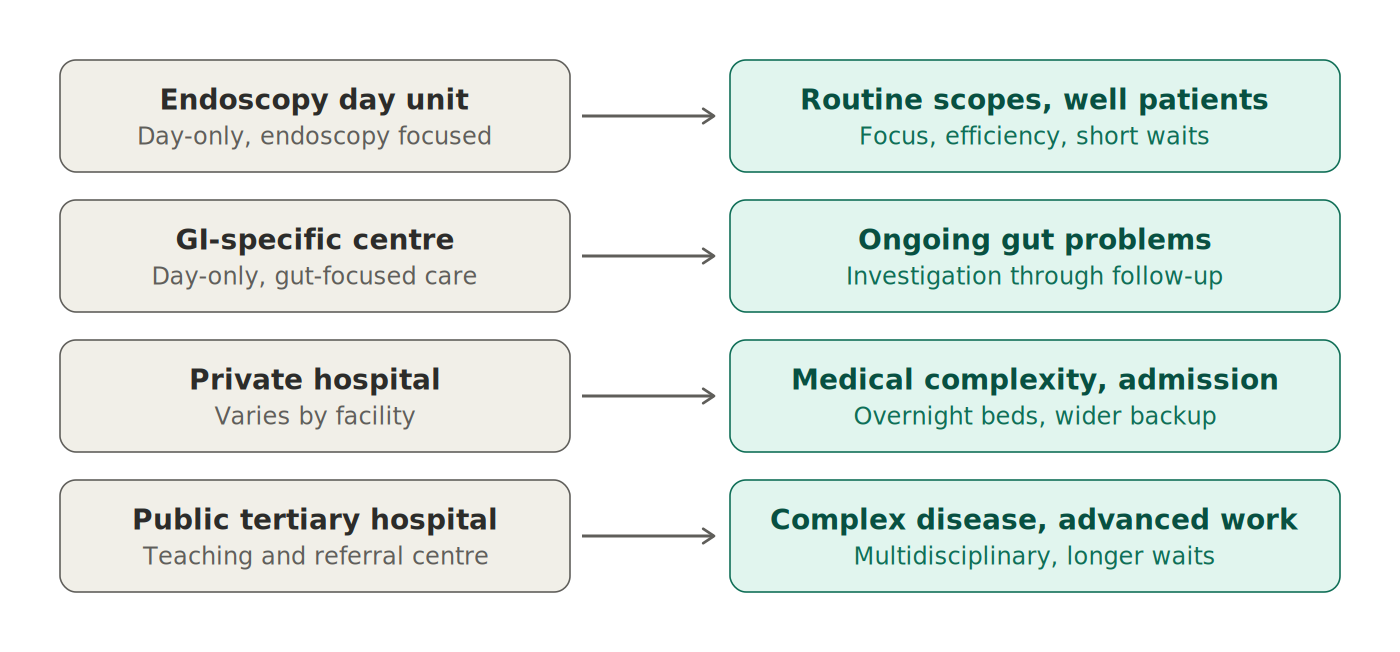
A note on my own position. I perform endoscopy across day surgery, gastroenterology-specific and private hospital settings. I've written this to describe what each type of facility is designed for rather than to argue that one is better, and I've deliberately avoided naming the individual sites I work at.
Three things decide the answer
Before looking at facility types, it helps to know what the decision actually turns on. There are three questions, and the third is the one patients almost never think to ask.
Who is the patient? A fit forty-year-old having a screening colonoscopy is a different proposition from an eighty-two-year-old with significant heart or lung disease, complex anticoagulation and a history of difficult anaesthesia. The procedure may be identical. The risk profile is not.
What is the procedure? "Having a scope" covers an enormous range. A routine diagnostic gastroscopy sits at one end. A large endoscopic mucosal resection, an ERCP, an endoscopic ultrasound or a third-space procedure such as POEM sits somewhere quite different, both in technical demand and in what might be needed afterwards.
What happens if Plan A changes? This is the question worth asking. Suppose a 40mm lesion turns up that wasn't expected. Suppose there is significant bleeding. Suppose sedation proves more complicated than anticipated. Suppose you need observation overnight rather than going home at lunchtime. What can be managed where you are, and what would require moving somewhere else?
Everything else in this article is really a longer answer to that third question.
The main types of facility
Dedicated endoscopy day units
These are day-only facilities whose work is endoscopy and little else. In New South Wales, private hospitals and day procedure centres are licensed under the Private Health Facilities Act 2007, administered by the NSW Ministry of Health. There are nineteen prescribed classes of health service a facility can be licensed for, and Gastrointestinal Endoscopy and Anaesthesia are two of them. A facility can hold more than one class. So an endoscopy day unit performing procedures under anaesthesia is not operating on a general permit — it is licensed specifically for that work and accredited against the national safety and quality standards.
Its strength is partly cost — the facility fee at a dedicated day unit is often lower than at a full private hospital, because you aren't paying for infrastructure you won't use. But the bigger advantage is workflow. A unit that does endoscopy all day develops a kind of institutional muscle memory: the nursing staff know bowel preparation and how it goes wrong, they know recovery after propofol, they know polypectomy aftercare and the pathology pathways. There are no orthopaedic lists or obstetric emergencies competing for the same theatres and the same staff. For a straightforward procedure in a well patient, that focus is a genuine advantage, and it usually comes with shorter waits and a more predictable day.
The limitation is in the name. A day unit is designed for patients who arrive, have their procedure and go home. If something unexpected requires prolonged observation, intensive medical management or surgical intervention, that generally means transfer to a hospital rather than a move to another part of the same building. Many day units say so plainly in their own patient information, and advise patients who become unwell after hours to contact their GP or attend an emergency department.
That isn't an argument against day surgery. It's an argument for choosing patients carefully, which is the whole point of this article.
Gastroenterology-specific centres
A small number of facilities are built around gastroenterology as a discipline rather than around procedures as a service. They combine consultation, investigation, endoscopy and ongoing treatment within one clinical ecosystem, often with dietetics, colorectal surgery and research activity alongside.
The value here is for the patient who has a gastrointestinal problem rather than simply a need for a scope. Refractory symptoms, recurrent C. difficile, complex inflammatory bowel disease, unusual infections, repeated investigations, anyone likely to need longitudinal gastroenterology care: in those situations, being inside a unit that thinks about nothing but the gut has real advantages over a single procedure booked in isolation.
The same caveat applies as for day units, though. Depth in one discipline is not the same as hospital breadth, and most such centres operate as day-stay facilities. A place can have extraordinary expertise in a narrow field precisely because it has chosen not to be everything.
Private hospitals
"Private hospital" is a broad label that tells you surprisingly little on its own. The useful question isn't whether a facility is a private hospital; it's what that particular hospital actually has.
Does it have overnight beds? A high dependency or intensive care unit? Medical cover overnight and at weekends? CT on site? Blood bank? Surgical backup? An emergency department? Those distinctions matter far more than the word on the sign, and they vary considerably between one private hospital and the next.
Where a hospital environment earns its value is when the chance of needing something beyond the endoscopy room rises. That might be significant cardiopulmonary disease, substantial anaesthetic risk, complicated anticoagulation, anticipated advanced therapeutic work, known difficult pathology, or a reasonable chance of needing admission afterwards. Larger private hospitals also tend to have colorectal surgery, oncology, radiology and gastroenterology working alongside each other, which matters if what's found needs more than a scope.
For a fit forty-five-year-old having an uncomplicated screening colonoscopy, the marginal value of all that infrastructure may be genuinely small. That is the part patients are rarely told.
Public tertiary hospitals
Sydney's major public teaching hospitals sit in a category of their own, and a different regulatory one: public hospitals are expressly excluded from the private health facilities licensing scheme described above, and are governed through the public health system instead.
Their endoscopy units perform some of the most sophisticated gastrointestinal work done anywhere in the country: advanced resection, ERCP and cholangioscopy, interventional endoscopic ultrasound, enteroscopy, manometry, third-space procedures, alongside specialist inflammatory bowel disease and liver services. For complex disease requiring several specialties, for advanced intervention, for serious comorbidity or for anything likely to need inpatient management, they are frequently the right destination and sometimes the only one.
Two practical differences are worth understanding.
The first is access. Public hospitals allocate endoscopy by clinical priority, and they give appropriate precedence to patients from their own area, existing patients and tertiary referrals. Waiting times for non-urgent procedures reflect that, and they can be long. Several units state explicitly that patients who need endoscopy after a clinic consultation may choose between the public list and a private facility. A public tertiary hospital is not designed to be the default destination for every routine screening colonoscopy, and doesn't claim to be.
The second is that teaching hospitals teach. Part of the procedure may be performed by an advanced trainee under consultant supervision. This is how every endoscopist in Australia, myself included, is produced, and supervised training in high-volume units is a large part of why the standard of endoscopy here is what it is. But it is reasonable to want to know in advance — and worth asking in private settings too, where lists get covered and plans change.
What actually changes between settings
Nothing in this table is a ranking. It's a description of what each type of facility is built to do, and the honest answer for several rows is "it depends on the individual facility" — which is itself the point. Facilities vary considerably within each category, so confirm the specifics with your specialist's rooms.
Endoscopy day unit | GI-specific centre | Private hospital | Public tertiary | |
Best suited to | Routine scopes, well patients | Ongoing gut problems | Medical complexity | Complex or advanced work |
Routine scope workflow | Excellent | Excellent | Good | Varies with demand |
Same-day discharge | By design | By design | Usual | Usual |
Overnight admission | Not usually | Not usually | Facility-dependent | Yes |
Intensive or high dependency care | Transfer if needed | Transfer if needed | Facility-dependent | Available at major centres |
Surgical and medical backup | Transfer if needed | Transfer if needed | Facility-dependent | Broadest |
Advanced endoscopy | Operator and facility dependent | Gut-focused, varies | Often available | Major strength |
Typical wait | Often short | Often short | Depends on the list | Clinical priority; can be long |
Choice of endoscopist | Usually yours | Within the centre | Usually yours | More constrained |
Cost pathway | Private; facility fee often lower | Private | Private | Public system |
Five things patients commonly assume, and why they don't quite hold
"A bigger hospital must be safer." Safety in endoscopy rests on appropriate patient selection, the operator, the anaesthetic care, the nursing, the equipment and the systems around them. The size of the building is a poor proxy for any of these. What a larger hospital genuinely offers is more options if something goes unexpectedly wrong, which matters a great deal for some patients and very little for others.
"A day surgery is basically a clinic." It isn't. Day-only facilities performing endoscopy under anaesthesia hold specific licence classes for both, and are accredited against the national safety and quality standards. They are hospitals in a legal and regulatory sense, designed for a defined scope of work.
"Public hospital endoscopy must be inferior." The opposite is closer to the truth at the complex end. Sydney's tertiary public units perform advanced procedures that are simply not available in most private settings, and manage disease that needs several specialties at once.
"Private means no waiting." Private access changes the pathway, but availability still depends on your specialist's list, the facility and the procedure. Some private endoscopy lists run booked out for weeks.
"The most expensive option must be the best." For a routine procedure in an appropriately selected low-risk patient, additional infrastructure may add very little. Paying for capability you will not use is not the same as paying for a better outcome.
Six questions to ask your gastroenterologist
You don't need to work any of this out yourself. You need to ask the person arranging the procedure to think about it out loud with you.
Is my procedure routine, or is there a reasonable chance it becomes complex?
Does anything in my medical history make one setting more appropriate than another?
Who will be looking after my sedation or anaesthesia, and who will be performing the procedure?
If something unexpected is found, can it be dealt with there, or would I need a second procedure elsewhere?
If I need observation or admission afterwards, what happens?
What will I actually pay, across all four components: the specialist's fee, the anaesthetist's fee, the facility fee and any insurance excess?
That last one deserves its own explanation, which I've written about separately in how to choose the right gastroenterologist in Sydney.
Where this lands
There is no ranking here, and anyone who offers you one is oversimplifying.
For a straightforward procedure in a well patient, a dedicated endoscopy day unit may be exactly the right environment, and the focus and efficiency of such a unit are real advantages rather than compromises. For a patient who is medically complex, or where advanced intervention or admission may be needed, a hospital setting offers options that matter. And for highly specialised disease or genuinely advanced procedures, the expertise of a particular unit matters far more than whether it happens to be public or private.
The right question was never "which is the best hospital in Sydney for a colonoscopy". It's "which setting suits this patient, this procedure, and what might happen if the day doesn't go to plan". Your gastroenterologist should be able to answer that for you, and should be glad you asked.
About this article
Written by Dr Jeffrey Tu MBBS FRACP, Gastroenterologist and Hepatologist, Shore Gastroenterology, Sydney. Last medically reviewed: September 2026.
This article is general information and is not a substitute for individual medical advice. Please see your GP for a referral appropriate to your circumstances.
References
NSW Ministry of Health. Licensing of private health facilities (Private Health Facilities Act 2007; Private Health Facilities Regulation 2024).
NSW Ministry of Health. Private health facilities: regulation and compliance.
Australian Commission on Safety and Quality in Health Care. Colonoscopy Clinical Care Standard, 2025.
Australian Commission on Safety and Quality in Health Care. National Safety and Quality Health Service Standards.
Gastroenterological Society of Australia / Conjoint Committee for the Recognition of Training in Gastrointestinal Endoscopy. Colonoscopy certification and recertification.
Comments